
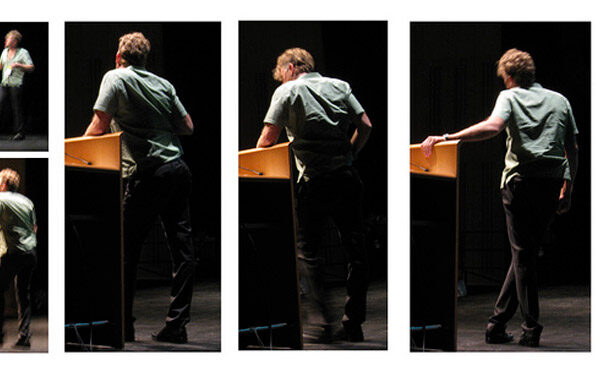
Communication is not always verbal.
Although unconscious, the audience pays attention to body language.
Speaker body language must tell the audience that s/he respects their personal space and is not negative, intrusive, or hostile.
Body language (the physical elements of communication) includes: eye contact, facial expressions, posture, and gestures / movement.
EYE CONTACT
A United States audience translates good, intermittent eye contact as confident and respectful. Making eye contact requires courage. Speakers should practice not only making eye contact, but also sharing it with as many members of an audience as possible.
FACIAL EXPRESSION
Appropriate facial expressions contribute to an effective speech. A speaker’s face supports the meaning of the speech. Usually, people watch the speaker’s face more than anything else during her/his presentation. The face tells all—beliefs and emotions.
All people share the following basic emotions: anger, disgust, fear, happiness, sadness, and surprise. How would these be conveyed in facial expressions?
POSTURE
Relax and open your body to face your audience. A speaker’s posture should be upright and demonstrate assertiveness. This tells the audience that there is no hidden agenda or deception. This posture is one of conviction and confidence.
Feet should be shoulder-width apart. Arms should be at your side (except for gesturing). Speakers should avoid a forward-sloping stance (too domineering) and a bent stance (without conviction).
Sitting or standing depends on formality of presentation and group size. If you are seated, sit up straight. It tells the audience that you are in control of yourself.
GESTURES & MOVEMENT
Formal speeches require the speaker to stand center-stage or at a podium.
Movement and gestures affect how the audience perceives a speaker. The body language of movement helps to maintain speaker enthusiasm and audience interest.
Allow your relaxed, uncrossed arms to hang naturally and use them for emphasis. Use gestures that are appropriate to what the message is. Do not repeat gestures or wring hands.
Self-touching gestures (fixing hair, rubbing hands) indicate that you’re nervous.
Use lively but not distracting movement.
We all use body language. At times, we may not be aware of what we are saying, but it is still being heard. Think about what your movements might be communicating to your audience, and make sure the message is what you want them to take home.
This information is discussed in our Public Speaking curriculum. If you’re looking for ways to improve your communication skills, register for one of our public classes.
Photo courtesy of Vincent LaConte
Other Resources:
10 Things Body Language Says About You (Video)
How To Read Body Language (Wiki-How)
8 Great Tricks for Reading People’s Body Language

Rich Atkins is the Managing Director of Improving Communications, a New York-based corporate training firm that, in addition to Speaker Services, offers Business Writing, Public Speaking & Presentation Skills, Sales and Negotiation, Customer Service, Leadership, Staff Development, and Human Resources training. He is also the Director of Improving Communications UK and Improving Communications IE.